No Rules Rules: Netflix and the Culture of Reinvention
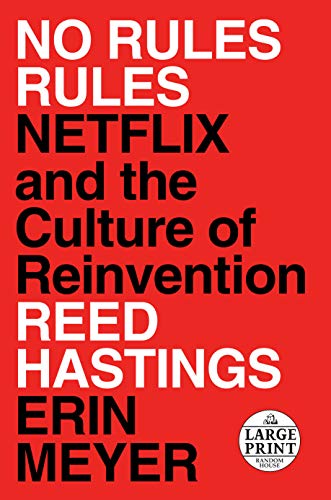
Link to Downlload ⇒ Downlload Now!
Link to Read ⇒ Reaad Now!
Review : The New York Times bestseller Shortlisted for the 2020 Financial Times & McKinsey Business Book of the Year Netflix cofounder Reed Hastings reveals for the first time the unorthodox culture behind one of the world's most innovative, imaginative, and successful companies There has never before been a company like Netflix. It has led nothing short of a revolution in the entertainment industries, generating billions of dollars in annual revenue while capturing the imaginations of hundreds of millions of people in over 190 countries. But to reach these great heights, Netflix, which launched in 1998 as an online DVD rental service, has had to reinvent itself over and over again. This type of unprecedented flexibility would have been impossible without the counterintuitive and radical management principles that cofounder Reed Hastings established from the very beginning. Hastings rejected the conventional wisdom under which other companies operate and defied tradition to instead build a culture focused on freedom and responsibility, one that has allowed Netflix to adapt and innovate as the needs of its members and the world have simultaneously transformed. Hastings set new standards, valuing people over process, emphasizing innovation over efficiency, and giving employees context, not controls. At Netflix, there are no vacation or expense policies. At Netflix, adequate performance gets a generous severance, and hard work is irrelÂevant. At Netflix, you don’t try to please your boss, you give candid feedback instead. At Netflix, employees don’t need approval, and the company pays top of market. When Hastings and his team first devised these unorthodox principles, the implications were unknown and untested. But in just a short period, their methods led to unparalleled speed and boldness, as Netflix quickly became one of the most loved brands in the world. Here for the first time, Hastings and Erin Meyer, bestselling author of The Culture Map and one of the world’s most influential business thinkers, dive deep into the controversial ideologies at the heart of the Netflix psyche, which have generated results that are the envy of the business world. Drawing on hundreds of interviews with current and past Netflix employees from around the globe and never-before-told stories of trial and error from Hastings’s own career, No Rules Rules is the fascinating and untold account of the philosophy behind one of the world’s most innovative, imaginative, and successful companies. Read more
Review : How should a modern company run? We are told that a modern company needs to be customer centric, employee empowering, deliver broad stakeholder returns and with agility to move from one opportunity to the next. This book provides a provocative answer to these questions direct from the CEO. Reed Hastings and Erin Meyer have actually written two books in one. One book is “NO RULES†and the other is Netflix and the culture of reinvention. The combination is powerful as Reed shares experiences and stories and Erin puts them in a broader context. This keeps the book from becoming preachy. This book is recommended, but not for the reasons one might think. Read this book as a leader, because it is possible to create a level of these results within the scope of your team. This is a book for leaders who want to understand how they can attract and create high performance by adopting these ideas where possible. Reading this book from an organizational transformation point of view, frankly, is futile and hopeless for one simple reason. Your company is not a high talent density company. That is the essential, foundational and core reason for NETFLIX’s success – they have, hire, keep and constantly upgrade their talent. Becoming a high talent dense company requires living the following actions that are the foundation of the book: • You build up talent tensity by creating a workforce of high performers • You introduce candor by encouraging loads of feedback • You remove controls such as vacation, travel and expense policies • You strengthen talent density by paying top of the market, always • You increase candor by emphasizing organizational transparency • You release more controls such as decision-making approvals • You max-up talent density by implementing the Keeper Test • Max-up Candor by creating circles of feedback • Eliminate most controls by leading with context and note control These seem like normal empowerment related topics. Beware the book talks about how NETFIX embodies them to a degree that makes them all but impossible for the vast majority of companies – like 98%. Many will read this book and pay lip service to these principles, some CHRO’s will stand up and say that they are a talent dense company, but these are aspirational at best and insincere at the other end of spectrum. High-density talent is the core of NETFLIX and its ability to execute these strategies effectively. They are good, not because they have good people, they are NETFLIX because they work hard to always have the BEST PEOPLE. There is no average at NETFLIX, all are way above average when they are there and when they fall back to average – “adequate performance gets a generous severance package.†The selected quotes from the book demonstrate the centrality of high talent density to the company and anyone seeking to adopt these ideas. “We learned that a company with really dense talent is a company everyone wants to work for. High performers especially thrive in environments where the overall talent density is high.†Page 7. “We’d found a way to give our high performers a little more control over their lives, and that control made everybody feel a little freer: because of our high-talent density, our employees were already conscientious and responsible.†Page 54. “Once you have a workforce made up of nearly exclusively of high performers, you can count on people to behave responsibly.†Page 69. “Dispersed decision-making can only work with high talent density and unusual amounts of organizational transparency. Without these elements, the entire premise backfires.†P. 131. “One of the reasons this (high density) is so difficult is many companies is because business leaders are continually telling their employees, ‘we are a family.’ But a high-talent-density work environment is not a family.†Page 166. “At Netflix, I want each manager to run her department like the best professional teams, working to create strong feelings of commitment, cohesion and camaraderie, while continually making tough decision to ensure the best player is manning each post.†Page 169. “Leading with context won’t work unless you have the right conditions in place. And the first prerequisite is high talent density.†Page 201. Overall the book is well worth your time. Its entertaining, eminently readable and enlightening. It contains a number of ideas that will become organizational and leadership buzzwords in the future. Just read it with the caveat that very few companies have the capacity or true desire to put these ideas into practice at the organizational level.
0 comments:
Post a Comment