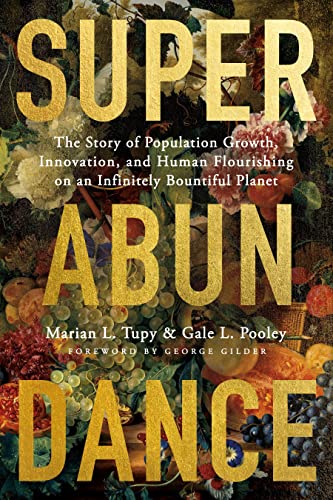
Superabundance: The Story of Population Growth, Innovation, and Human Flourishing on an Infinitely Bountiful Planet
Link to Downlload ⇒ Downlload Now!
Link to Read ⇒ Reaad Now!
Review : “For centuries, the ivory towers of academia have echoed this sentiment of multitudinous ends and limited means. In this supremely contrarian book, Tupy and Pooley overturn the tables in the temple of conventional thinking. They deploy rigorous and original data and analysis to proclaim a gospel of abundance. Economics―and ultimately, politics―will be enduringly transformed.†―George Gilder, author of Life after Google: The Fall of Big Data and the Rise of the Blockchain Economy Generations of people have been taught that population growth makes resources scarcer. In 2021, for example, one widely publicized report argued, “The world's rapidly growing population is consuming the planet's natural resources at an alarming rate . . . the world currently needs 1.6 Earths to satisfy the demand for natural resources . . . [a figure that] could rise to 2 planets by 2030.†But is that true? After analyzing the prices of hundreds of commodities, goods, and services spanning two centuries, Marian Tupy and Gale Pooley found that resources became more abundant as the population grew. That was especially true when they looked at “time prices,†which represent the length of time that people must work to buy something. To their surprise, the authors also found that resource abundance increased faster than the population―a relationship that they call “superabundance.†On average, every additional human being created more value than he or she consumed. This relationship between population growth and abundance is deeply counterintuitive, yet it is true. Why? More people produce more ideas, which lead to more inventions. People then test those inventions in the marketplace to separate the useful from the useless. At the end of that process of discovery, people are left with innovations that overcome shortages, spur economic growth, and raise standards of living. But large populations are not enough to sustain superabundance―just think of the poverty in China and India before their respective economic reforms. To innovate, people must be allowed to think, speak, publish, associate, and disagree. They must be allowed to save, invest, trade, and profit. In a word, they must be free. Read more
Review : Today, obesity is a common disease among all age-classifications from toddlers to middle-age and beyond, including all races and also, all religions. Even amongst poor people! Hence the appropriate title of this marvelous book 'ABUNDANCE'. Hasn't anyone learned? There is plenty to eat! Human population growth does not hinder prosperity. That's all there is to it. On the contrary: people are the raw material of economic growth. The more people the more prosperity and the more food. It's counter-intuitive but it's true. The dyspeptic gloom-and-doomers have now invented this vague/ meaningless word called 'sustainability'. Go try typing in the Amazon search bar "sustainability" and there are thousands of titles with more being constantly published. Sustainability is just a euphemism for Malthusian. It's all such foolishness; i am not being incurably optimistic. We certainly have our worldwide and domestic problems e.g. crime, lack of morality, and so on. But there is no shortage of food, oil, or any other commodity. The authors use "time-prices" to measure today's purchasing power. "We buy things with money; we pay for them with time". It's an excellent way to evaluate our physical good fortune in today's changing world. Purchase this book and study the statistics i.e., what consumption items really cost [especially as a percentage of our disposable income]. Guaranteed: you'll enjoy this fine book which is armed with useful statistics to prove the Malthusians wrong. It's a terrific read.
0 comments:
Post a Comment