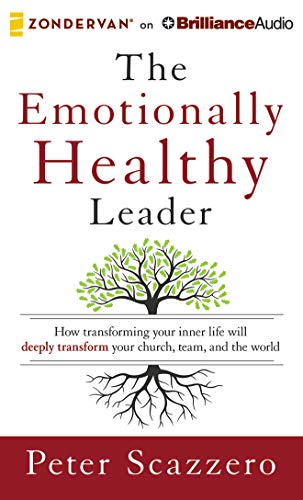
The Emotionally Healthy Leader: How Transforming Your Inner Life Will Deeply Transform Your Church, Team, and the World
Link to Downlload ⇒ Downlload Now!
Link to Read ⇒ Reaad Now!
Review : There is an immense difference between a Christian and a secular leader. Secular leaders learn best practices and strategies from the most successful global leaders and then do their best to implement them. They are secular in that they manage to lead without God. While we can, and should, learn from best secular leadership practices, Christian leadership is different. Christian leaders lead from an interior life with Jesus Christ. Our lives are defined by Jesus who calls us to follow Him, and do His will. We lead from a position of dependence and communion with Him. Moreover, our vision is more than earthly measures of success. Christian leaders lead people to Jesus so that their lives might be powerfully transformed by Him. Yet we cannot give what we do not possess. We must be increasingly transformed first. The first half of The Emotionally Healthy Leader looks at four foundational areas often overlooked in developing leaders: facing our shadow, leading out of our marriage or singleness, slowing down for loving union with Jesus, and practicing Sabbath delight. Who we are, our “being,†is primary, impacting all our exterior activity. Scazzero then examines the intersection of our inner lives with the practical, everyday “doing†of leadership – planning and decision-making, culture and team buildings, community and dual relationships, and endings and new beginnings. Forged out of hard lessons learned in 26 years of leading a large, growing, complex, missional, multiracial church in New York City, The Emotionally Healthy Leader offers a unique integration of how who we are profoundly impacts what we do as leaders. It looks at how all our decisions and activities each day flow out of our inner walk with Christ. The Emotionally Healthy Leader goes beyond a quick fix or a new technique to core, beneath-the-surface issues of uniquely Christian leadership. This audiobook is more than a book you will listen to; it is a resource you will come back to over and over again. Read more
Review : Bottom Line Up Front: Very well written book that covers an important topic – Burnout in ministry. Scazzero also covers a range of other important topics in Christian leadership (e.g. use of power, navigating endings and beginnings) that the rest of the body of Christian leadership literature is nearly devoid of, making this an important reference work. So why a 4 star instead of a 5 star review? The book comes dangerously close and at one point to the idolatry line in the discussion of marriage (flirting with spousal worship). Additionally, in the same discussion section the book gets a little quirky in a short anecdote regarding nakedness (i.e. literally taking all your clothes off daily in the presence of your spouse for 20 min), hinting at use of this practice as a marriage building daily discipline. Finally, as the book is primarily written for an audience of Christian leaders, I found it light on biblical underpinning. Not devoid, just light. There were many missed opportunities to shine the light of scripture on much of what Scazzero provides, leaving the impression that the book is more an assembly of well-informed Christian opinion and experience rather than a work built solidly on biblical foundations. This necessarily removes some of the authority of the assertions. If you are able to look past these things you will likely rate the book, as many have - a 5 star work, and enjoy it greatly. Amplifying Remarks follow: The basic premise of the book is that many in full (or nearly so) vocational ministry are overworked, burned out, in marriages that are running on fumes, consumed with busyness unable to rest, and physically, emotionally, and spiritually exhausted. Working full time in vocational ministry myself, this is an assertion I see (and have occasionally experienced) being lived out on the front lines of ministry every day. Thus, I feel like this is a book that finds an easy audience, willing to listen. Much of the rest of the book is about unpacking solutions to this root issue. The basic approach is finding and sustaining life and ministry rhythms to replace these unhealthy practices that lead to burnout. Drawing on a number monastic traditions Scazzero makes a case for the practice of spiritual disciplines, (silence, solitude, deep engagement in alone times with God, prayer, rest, sabbath keeping, etc) as helpful in breaking these unhealthy cycles and patterns. The author suggests breaking these cycles by transforming the inner life and allowing this transformed inner life to drive new healthy patterns and outward expressions as Christian leaders lead others from this new place of balance. The book suggests that inner life transformation begins with the practice of four key elements which are: -Face Your Shadow (Unhealthy practice, perhaps shaped by your family of origin, that often shapes your interactions with others) - Lead out of Your Marriage/Singleness (exactly as it sounds) - Slow down for Loving Union (Taking time to relax, abide in Christ, and let Him take on the heavy lifting that you have so desperately been trying to control) -Practice Sabbath Delight (Again….exactly as it sounds) One endearing aspect of this book throughout is that the book doesn’t just mention ideas but rather puts meat to them by laying out several useable and practical suggestions about how to make each a regular pattern in a new transformed inner life. This section is certainly no exception. I particularly liked the section within the inner life discussion where Scazzero presents the idea of establishing a “Rule of Lifeâ€. This “Rule of Life†concept is taken from the practices of the Benedictine Monastic tradition and involves an exercise in finding, giving, and receiving God’s love across the full spectrum of life as viewed through four separate lenses: Prayer, Rest, Relationships, and Work. Very practical and very well presented. The chapter on “Finding Sabbath Delightâ€, is also practical, excellent, and much needed. My own observation (and Scazzero’s) is that the practice of regular sabbath keeping seems to have nearly disappeared from the 21st century Church, especially in North America. Sadly, this has taken a toll on those who lead it. This section of the book, if truly widely practiced, would do much to restore that. In part II of the book (The Outer Life) I was most grateful for the author’s inclusion of some practical information on the use of power in ministry and the very thoughtful and practical approaches he outlines to healthy “endings†and “new beginningsâ€. His approach to these obscure but very important topics, and the manner and lucidity with which he presents them, make it clear that his wise recommendations have been formed in the crucible of highly successful experience – a reward not many can claim. As stated above, these are just topics which you rarely find even mentioned in other books on Christian leadership, so there inclusion here is most helpful. Finally, the quote that best speaks to what this book is really about: “You can’t live at warp speed, without warping your soulâ€. Pg. 129. In light of that this book is ultimately about a much needed “unwarping the soul†among Church leadership!
0 comments:
Post a Comment