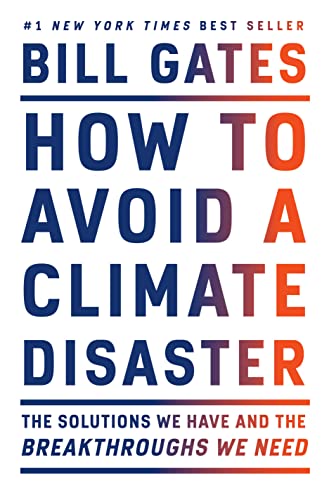
How to Avoid a Climate Disaster: The Solutions We Have and the Breakthroughs We Need
Link to Downlload ⇒ Downlload Now!
Link to Read ⇒ Reaad Now!
Review : #1 NEW YORK TIMES BEST SELLER • In this urgent, authoritative book, Bill Gates sets out a wide-ranging, practical—and accessible— plan for how the world can get to zero greenhouse gas emissions in time to avoid a climate catastrophe. Bill Gates has spent a decade investigating the causes and effects of climate change. With the help of experts in the fields of physics, chemistry, biology, engineering, political science, and finance, he has focused on what must be done in order to stop the planet's slide to certain environmental disaster. In this book, he not only explains why we need to work toward net-zero emissions of greenhouse gases, but also details what we need to do to achieve this profoundly important goal. He gives us a clear-eyed description of the challenges we face. Drawing on his understanding of innovation and what it takes to get new ideas into the market, he describes the areas in which technology is already helping to reduce emissions, where and how the current technology can be made to function more effectively, where breakthrough technologies are needed, and who is working on these essential innovations. Finally, he lays out a concrete, practical plan for achieving the goal of zero emissions—suggesting not only policies that governments should adopt, but what we as individuals can do to keep our government, our employers, and ourselves accountable in this crucial enterprise. As Bill Gates makes clear, achieving zero emissions will not be simple or easy to do, but if we follow the plan he sets out here, it is a goal firmly within our reach. Read more
Review : The book entitled: “How to Avoid a Climate Disaster: The Solutions We Have and the Breakthroughs We Need†by Bill Gates is a well written treatise on climate change worth purchasing and reading including actions needed. As an entrepreneur and capitalist now focused on giving his accumulated wealth to important world charities, Gates, with the aid of many acknowledged contributors writes a compelling outline of what the private sector and government should do in a coordinated manner to combat climate change. In a perfect world, one could speculate that the book should have been written by John Kerry, the new Climate czar but it still could be used as a road map for aggressive coordinated actions to be taken to control man-made climate change. Short of that, the book provides great technical detail and insight into a balanced approach to moving forward with both policy and technical actions. The main theme of the book is: “Fifty-one billion is how many tons of greenhouse gases the world typically adds to the atmosphere every year. … Zero is what we need to aim for.†The author states: “It’s hard to say exactly how much of America’s electricity will come from renewables in the end, but what we do know is that between now and 2050 we have to build them much faster—on the order of 5 to 10 times faster—than we’re doing right now.†The book also has a rational balanced approach stating for example: “In other words, fossil fuels are everywhere. Take oil as just one example: The world uses more than 4 billion gallons every day. When you’re using any product at that kind of volume, you can’t simply stop overnight.†Gates goes on to state: “Eventually it sank in. The world needs to provide more energy so the poorest can thrive, but we need to provide that energy without releasing any more greenhouse gases.†This book contains endorsements for several highly recommended readings that this reviewer has not yet read but suspects that the interested individual may wish to pursue reading them. The reader of Gate’s most comprehensive excellent book is forewarned and should be wary of several potentially misleading points or subtleties. Often the author himself points these out. Perhaps because he sees climate change as such a critical world issue, he has invested his own resources in not only writing this book but also investing in companies to contribute to solving the climate change problems; one therefore might be suspect of the potential for conflict of interest. Another more nuanced observation is that the book often slips from facts based upon past data to predictions about what the future holds. And while the book includes extensive notes at the end, the book does not make it apparent to the casual reader in the main text what is true and what is predicted, leaving the reader to trust the excellent salesmanship of the author to believe the points that he is making or sometimes trying to make. Gates writes a little about the Covid-19 pandemic (including our failure to prepare for it despite warnings) and how, while it did reduce greenhouse gases, it was not as much as one might have expected. To provide historical context, Gates states: “During the last ice age, the average temperature was just 6 degrees Celsius lower than it is today. During the age of the dinosaurs, when the average temperature was perhaps 4 degrees Celsius higher than today, there were crocodiles living above the Arctic Circle.†In terms of climate change challenges, the author goes on to remind us that: “Carbon dioxide is the most common greenhouse gas, but there are a handful of others, such as nitrous oxide and methane.†Gates goes on to state: “The 51 billion tons I keep mentioning is the world’s annual emissions in carbon dioxide equivalents. You may see numbers like 37 billion elsewhere—that’s just carbon dioxide, without the other greenhouse gases—or 10 billion, which is just the carbon itself. … Greenhouse gas emissions have increased dramatically since the 1850s due to human activity, such as burning fossil fuels. … So that’s the first part of the answer to the question “Why do we have to get to zero?â€â€”because every bit of carbon we put into the atmosphere adds to the greenhouse effect. … There’s no getting around physics. Carbon dioxide emissions are on the rise, and so is the global temperature.†As illustrative of what is fact and what Gates predicts based upon the available scientific knowledge, Gates states: “What We Do and Don’t Know … One problem is that computer models are far from perfect. … The earth is warming, it’s warming because of human activity, and the impact is bad and will get much worse. … We’ve already raised the temperature at least 1 degree Celsius since preindustrial times, and if we don’t reduce emissions, we’ll probably have between 1.5 and 3 degrees Celsius of warming by mid-century, and between 4 and 8 degrees Celsius by the end of the century. … A hotter climate means there will be more frequent and destructive wildfires. … California is a dramatic example of what’s going on. Wildfires now occur there five times more often than in the 1970s, largely because the fire season is getting longer and the forests there now contain much more dry wood that’s likely to burn.†The author goes on to state: “If the temperature rises by 2 degrees Celsius, coral reefs could vanish completely, destroying a major source of seafood for more than a billion people. … In the worst drought ever recorded in Syria—which lasted from 2007 to 2010—some 1.5 million people left farming areas for the cities, helping to set the stage for the armed conflict that started in 2011. That drought was made three times more likely by climate change. By 2018, roughly 13 million Syrians had been displaced. … In the next decade or two, the economic damage caused by climate change will likely be as bad as having a COVID-sized pandemic every 10 years. And by the end of the 21st century, it will be much worse if the world remains on its current emissions path.†Gates, in a chapter entitled: “THIS WILL BE HARD†states “… fossil fuels are everywhere. Take oil as just one example: The world uses more than 4 billion gallons every day. When you’re using any product at that kind of volume, you can’t simply stop overnight. … the amount of energy used per person will go up, and so will the amount of greenhouse gases emitted per person. … The global population is headed toward 10 billion by the end of the century, … We need to get to zero—producing even more energy than we do today, but without adding any carbon to the atmosphere—.†The author explains: “Another argument you often hear goes like this: Yes, climate change is real, and its effects will be bad, and we have everything we need to stop it. Between solar power, wind power, hydropower, and a few other tools, we’re good. It’s simply a matter of having the will to deploy them. Chapters 4 through 8 explain why I don’t buy that notion. We have some of what we need, but far from all of it. No single country wants to pay to mitigate its emissions unless everyone else will too. That’s why the Paris Agreement, in which more than 190 countries signed up to eventually limit their emissions, was such an achievement. Not because the current commitments will make a huge dent in emissions— but because it was a starting point that proved global cooperation is possible.†In order to separate the forest from the trees and focus on important issues, Gates goes on to articulate “Five Questions to Ask in Every Climate Conversation†and goes on to introduce the concept of “These additional costs are what I call Green Premiums.†as a method of identifying the short term costs of “going green†and goes on to state “You can imagine Green Premiums high enough that the United States is willing and able to pay them but India, China, Nigeria, and Mexico are not. We need the premiums to be so low that everyone will be able to decarbonize.†Writing in 2021 illustrative of the challenge, Gates states: “All told, fossil fuels provide two-thirds of the world’s electricity. Solar and wind, meanwhile, account for 7 percent.†In terms of options, the author writes that: “Small-scale solar can be an option for people in poor, rural areas who need to charge their cell phones and run lights at night. But that kind of solution is never going to deliver the massive amounts of cheap, always-available electricity these countries need to jump-start their economies. They’re looking to do what China did: grow their economies by attracting industries like manufacturing and call centers—the types of businesses that demand far more (and far more reliable) power than small-scale renewables can provide today. … If these countries opt for coal plants, as China and every rich country did, it’ll be a disaster for the climate. But right now, that’s their most economical option.†Gates states: “Germany produced about 10 times more solar in June 2018 than it did in December 2018. In fact, at times during the summer, Germany’s solar and wind plants generate so much electricity that the country can’t use it all. When that happens, it ends up transmitting some of the excess to neighboring Poland and the Czech Republic, whose leaders have complained that it’s straining their own power grids and causing unpredictable swings in the cost of electricity. ... completely decarbonizing America’s power grid by 2050 will require adding around 75 gigawatts of capacity every year for the next 30 years. … But more efficient panels and turbines aren’t enough …†In terms of “Making Carbon-Free Electricity and Nuclear fission†Gates writes, The United States gets around 20 percent of its electricity from nuclear plants; France has the highest share in the world, getting 70 percent of its electricity from nuclear. … In 2018, researchers at the Massachusetts Institute of Technology analyzed nearly 1,000 scenarios for getting to zero in the United States; all the cheapest paths involved using a power source that’s clean and always available—that is, one like nuclear power. … High-profile accidents at Three Mile Island in the United States, Chernobyl in the former U.S.S.R., and Fukushima in Japan put a spotlight on all these risks.†But goes on to state: “Nuclear power kills far, far fewer people than cars do. For that matter, it kills far fewer people than any fossil fuel. … Nevertheless, we should improve it, just as we did with cars, by analyzing the problems one by one and setting out to solve them with innovation.†The author explains in considerable detail that materials like steel and concrete generate greenhouse gases and how getting to zero requires attention to these processes. Gates explains: “In short, we make materials that have become just as essential to modern life as electricity is. We’re not going to give them up. … how we can keep producing these materials without making the climate unlivable. For the sake of brevity, we’ll focus on three of the most important materials: steel, concrete, and plastic.†Going on to provide some technical details, Gates states: “To make steel, you need to separate the oxygen from the iron and add a tiny bit of carbon. You can accomplish both at the same time by melting iron ore at very high temperatures … A bit of the carbon bonds with the iron, forming the steel we want, and the rest of the carbon grabs onto the oxygen, forming a by-product we don’t want: carbon dioxide. Quite a bit of carbon dioxide, in fact. Making 1 ton of steel produces about 1.8 tons of carbon dioxide. … To make cement, you need calcium. To get calcium, you start with limestone—which contains calcium plus carbon and oxygen—and burn it in a furnace along with some other materials. … Make a ton of cement, and you’ll get a ton of carbon dioxide.†Gates then moves on to discuss the significant tons of carbon equivalent gases created by agriculture, having earlier in the book explained some of the nuances of methane versus carbon dioxide gases. Consistent with part of this theme to tap into innovation, Gates points out: “In 1968, an American biologist named Paul Ehrlich published a best-selling book called The Population Bomb, … Ehrlich wrote. “In the 1970s and 1980s hundreds of millions of people will starve to death … None of this came to pass. In the time since The Population Bomb came out, India’s population has grown by more than 800 million people—it’s now more than double what it was in 1968—but India produces more than three times as much wheat and rice as it did back then, and its economy has grown by a factor of 50. Why? What did Ehrlich and other doomsayers miss? They didn’t factor in the power of innovation. They didn’t account for people like Norman Borlaug, the brilliant plant scientist … Starvation plummeted, and today Borlaug is widely credited with saving a billion lives. He won the Nobel Peace Prize in 1970,†Illustrative of the incredible technical detail that Gates pulls together in this book: “All told, fertilizers were responsible for roughly 1.3 billion tons of greenhouse gas emissions in 2010, and the number will probably rise to 1.7 billion tons by mid-century... the American-style diet is responsible for almost as many emissions as all the energy Americans use in generating electricity, manufacturing, transportation, and buildings.†In terms of another important area of focus for reducing carbon, Gates writes: in “CHAPTER 7 HOW WE GET AROUND†16 percent of 51 billion tons a year (total emissions to be eliminated) “Gas contains an amazing amount of energy—In the United States, gasoline is also remarkably cheap, right—gallon for gallon, gasoline is cheaper than Two Buck Chuck (Wine). … keep these two facts about gasoline in mind: It packs a punch, and it’s cheap. … The twin concepts of energy delivered per unit of fuel and per dollar spent are going to matter a lot as we look for ways to decarbonize our transportation system.†The author discusses at length electric vehicles, batteries and the success (or lack) in investing in battery technology.†He goes on to report: “The city of Shenzhen, China—home to 12 million people—has electrified its entire fleet of more than 16,000 buses and nearly two-thirds of its taxis.†And from a systems point of view, Gates states: “a typical truck running on diesel can go more than 1,000 miles without refueling. … Although electricity is a good option when you need to cover short distances, it’s not a practical solution for heavy, long-haul trucks.†Providing examples of government policies that worked, Gates reminds the reader that: “What’s now known as the Great Smog of London killed at least 4,000 people. …the 1950s and 1960s marked the arrival of air pollution as a major cause of public concern in the United States and Europe, and policy makers responded quickly. The next year, the British government enacted the Clean Air Act, which created smoke-control zones throughout the country where only cleaner-burning fuels could be used. Seven years later, America’s Clean Air Act established the modern regulatory system for controlling air pollution in the United States; … The U.S. Clean Air Act did what it was supposed to do—get poisonous gases out of the air—and since 1990 the level of nitrogen dioxide in American emissions has dropped by 56 percent, carbon monoxide by 77 percent, and sulfur dioxide by 88 percent.†And goes on to state: “we need the government to play a huge role in creating the right incentives and making sure the overall system will work for everyone.†The author summarizes: “Science tells us that in order to avoid a climate catastrophe, rich countries should reach net-zero emissions by 2050. … 2030 is not realistic. … there’s simply no way we’ll using them widely within a decade. … What we can do—and need to do—in the next 10 years is adopt the policies that will put us on a path to deep decarbonization by 2050.â€
0 comments:
Post a Comment