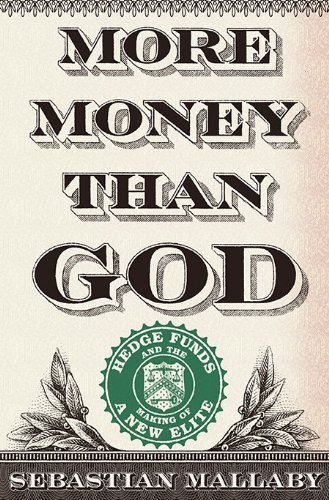
More Money Than God: Hedge Funds and the Making of a New Elite
Link to Downlload ⇒ Downlload Now!
Link to Read ⇒ Reaad Now!
Review : The first authoritative history of hedge funds-from their rebel beginnings to their role in defining the future of finance. Based on author Sebastian Mallaby's unprecedented access to the industry, including three hundred hours of interviews, More Money Than God tells the inside story of hedge funds, from their origins in the 1960s and 1970s to their role in the financial crisis of 2007-2009. Wealthy, powerful, and potentially dangerous, hedge fund moguls have become the It Boys of twenty-first Âcentury capitalism. Ken Griffin of Citadel started out trading convertible bonds from his dorm room at Harvard. Julian Robertson staffed his hedge fund with college athletes half his age, then he flew them to various retreats in the Rockies and raced them up the mountains. Paul Tudor Jones posed for a magazine photograph next to a killer shark and happily declared that a 1929-style crash would be "total rock-and-roll" for him. Michael Steinhardt was capable of reducing underlings to sobs. "All I want to do is kill myself," one said. "Can I watch?" Steinhardt responded. Finance professors have long argued that beating the market is impossible, and yet drawing on insights from physics, economics, and psychology, these titans have cracked the market's mysteries and gone on to earn fortunes. Their innovation has transformed the world, spawning new markets in exotic financial instruments and rewriting the rules of capitalism. More than just a history, More Money Than God is a window on tomorrow's financial system. Hedge funds have been left for dead after past financial panics: After the stock market rout of the early 1970s, after the bond market bloodbath of 1994, after the collapse of Long Term Capital Management in 1998, and yet again after the dot-com crash in 2000. Each time, hedge funds have proved to be survivors, and it would be wrong to bet against them now. Banks such as CitiGroup, brokers such as Bear Stearns and Lehman Brothers, home lenders such as Fannie Mae and Freddie Mac, insurers such as AIG, and money market funds run by giants such as Fidelity-all have failed or been bailed out. But the hedge fund industry has survived the test of 2008 far better than its rivals. The future of finance lies in the history of hedge funds. Read more
Review : Sebastian Mallaby, a former correspondent for The Economist magazine, is clear on where he stands on the issue of hedge funds regulation. He is against it. With the possible exception of a few systemically significant funds, he thinks regulation would bring more harm than good, and that there are more pressing concerns for fixing the global financial system. Not that hedge funds are a sideshow. Mind you, they manage close to two trillion dollars, and their management style and compensation practices tend to define the zeitgeist on the trading floors of financial institutions. Hedge funds are cool: as Mallaby shows, they are definitely the place to be for smart people bent on making serious money, or for those with the ambition to rewrite the rules of financial theory. Hedge funds are defined by four characteristics: they stay under the radar screen of regulatory authorities; they charge a performance fee; they are partially isolated from general market swings; and they use leverage to take short and long positions on markets. Most importantly, in a financial system riddled with conflicts of interests and skewed incentives, hedge funds get their incentives right. As a result, according to Mallaby, they do not wage any systemic threat to the financial system, and they may even provide part of the solution to our post-crisis predicament. The first set of well-aligned incentives deals with the issue of ownership. Hedge fund managers mostly have their own money in their funds, so they are speculating with capital that is at least partly their own--a powerful incentive to avoid losses. By contrast, bank traders generally face fewer such restraints: they are simply risking other people's money. Partly as a consequence, the typical hedge fund is far more cautious in its use of leverage than the typical bank. The average hedge fund borrows only one or two times its investors' capital, and even those that are considered highly leveraged borrow less than ten times. Meanwhile, investment banks such as Goldman Sachs or Lehman Brothers were leveraged thirty to one before the crisis, and commercial banks like Citi were even higher by some measures. As Mallaby notes, hedge funds are paranoid outfits, constantly in fear that margin calls from brokers or redemptions from clients could put them out of business. They live and die by their investment returns, so they focus on them obsessively. The second set of incentives deals with how hedge funds operate. They are usually better managed than investment banks. Their management culture tends to encourage team spirit and collaborative work as much as individual performance. Alfred Winslow Jones, the originator of the first hedge fund and the "big daddy" of the whole industry, invented a set of management tools and compensation practices to get the most from his brokers and managers. These innovations quickly paid off: whereas investors usually waited for company filings to arrive in a bundle from the post office, Jones' employees were stationing at the SEC's offices to read the statements the moment they came out. At a time when trading was considered a dull, back-office task, not something that a brilliant analyst would get involved with, Michael Steinhardt, another pioneer of the industry, would sit on his own trading desk and initiate the trading of large blocks of stocks with the seniority to risk millions on his personal authority. Other funds introduced a more scholarly approach to management. At the Commodities Corporation, which combined econometric modeling and chart reading, anyone who blew half of his initial capital had to sell all his positions and take a month off. He was required to write a memo to the management explaining his miscalculations. At LTCM, John Meriwether recruited young PhDs and encourage them to stay in touch with cutting-edge research; they would visit finance faculties and go out on the academic conference circuit. At Renaissance Technologies, the holding company of the flagship fund Medallion, Jim Simons gathered a team of mathematicians, astronomers, code breakers and computer translation experts that were so well ahead of the curve that they gave up reading academic finance journals altogether. Their office spaces bore signs claiming that "the best research never gets published" and papers explaining "why most published research findings are wrong". Hedge funds have a powerful incentive to improve upon existing knowledge, and market practitioners have often been ahead of academic theorists. They poked holes in the efficient-market theory long before the hypothesis came into disrepute among researchers. As Mallaby notes, innovation is often ascribed to big theories fomented in universities and research parks. But the truth is that innovation frequently depends less on grand academic breakthroughs than on humble trial and error--on a willingness to go with what works, and never mind the theory that may underlie it. A.W. Jones, the founder of the industry, had anticipated the rules of portfolio selection before Harry Markowitz formalized them in 1952. By the time William Sharpe proposed a simple rule for calculating the correlation between each stock and the market index in 1963, Jones had been implementing his advice for more than a decade. The most important set of incentives is that hedge funds are not too big to fail, and therefore they do not cast systemic risk over the stability of the whole market. The great majority of hedge funds are too small to threaten the broader financial system. They are safe to fail, even if they are not fail-safe. There is no precedent that says that the government stands behind them. Even when LTCM collapsed in 1998, the Fed oversaw its burial but provided no taxpayer money to cover its losses. By contrast, the recent financial crisis has compounded the moral hazard at the heart of finance: Banks that have been rescued can be expected to be rescued all over again the next time they blow up; because of that expectation, they have weak incentives to avoid excessive risks, making blowup all too likely. According to Mallaby, some of the perverse incentives that banks face come from regulation. Rather than running their books in a way that rigorous analysis suggests will be safe, banks sometimes run their books in a way that the capital requirements deem to be safe, even when it isn't. By contrast, hedge funds are in the habit of making their own risk decisions, undistracted by regulations and the false security provided by credit ratings. As a result, the hedge fund sector as a whole survived the subprime crisis extraordinarily well. By and large, it avoided buying toxic mortgage securities and often made money by shorting them. As Mallaby shows, hedge funds are a diverse lot. Following the fall of Askin Capital Management in 1994, George Soros declared to a Congress hearing that "there is as little in common between my type of hedge funds and the hedge fund that was recently liquidated as between the hedgehog and the people who cut the hedges in the summer." Nowadays hedge funds operate in merger arbitrage, long/short equity investing, credit arbitrage, statistical arbitrage, subprime assets, and all the other segments of market investment. And yet hedge funds have been equally vilified, mostly by people, institutions, and countries that stand at the other end of their investment strategies. Conversely, as Mallaby notes, "the countries that like hedge funds the best are also the ones that host them." One may also conjecture that countries that use hedge funds for their sovereign wealth investments will also develop a liking for them, as did universities endowments and other institutional investors looking for higher returns. I read this book after a series of popular essays on financial markets and the recent subprime crisis. I have no direct knowledge of the hedge fund or banking sector, and no practical experience of portfolio management. The names and faces of the people presented in the picture portfolio were all unfamiliar to me, with the possible exception of George Soros. More Money Than God therefore provided a useful introduction to a set of financial institutions that often appear collectively in the news, but that are not commonly analyzed as distinct managing entities or put in a historical perspective. Sebastian Mallaby revisits key episodes of recent financial history, from the Black Monday market crash of October 19, 1987, to the breakup of the sterling peg in 1992, the attacks on the Thai baht during the Asian crisis of 1997, the LTCM collapse in 1998, and the less well-reported quant quake of August, 2007. As of the debate whether hedge funds should be regulated or not, although I tend to err on the side of regulation in general terms, I must confess that Mallaby presents cogent arguments, and I am convinced that his voice will have to be reckoned with in future discussions on the matter.
0 comments:
Post a Comment