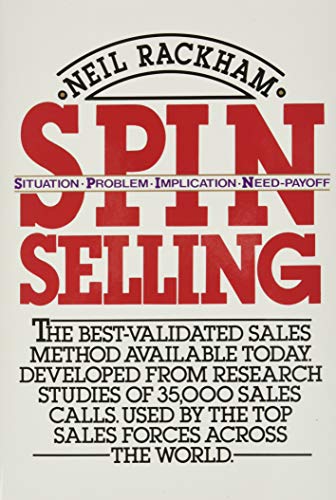
SPIN Selling
Link to Downlload ⇒ Downlload Now!
Link to Read ⇒ Reaad Now!
Review : Written by Neil Rackham, former president and founder of Huthwaite corporation, SPIN Selling is essential reading for anyone involved in selling or managing a sales force. Unquestionably the best documented account of sales success ever collected and the result of the Huthwaite corporation's massive 12 year, $1 million dollar research into effective sales performance, this groundbreaking resource details the revolutionary SPIN (Situation, Problem, Implication, Need payoff) strategy. In SPIN Selling, Rackham, who has advised leading companies such as IBM and Honeywell delivers the first book to specifically examine selling high value product and services. By following the simple, practical, and easy to apply techniques of SPIN, readers will be able to dramatically increase their sales volume from major accounts. Rackham answers key questions such as “What makes success in major sales†and “Why do techniques like closing work in small sales but fail in larger ones?†You will learn why traditional sales methods which were developed for small consumer sales, just won't work for large sales and why conventional selling methods are doomed to fail in major sales. Packed with real world examples, illuminating graphics, and informative case studies and backed by hard research data SPIN Selling is the million dollar key to understanding and producing record breaking high end sales performance. Sales Behavior and Sales Success. Obtaining Commitment: Closing the Sale. Customer Needs in the Major Sale. The SPIN Strategy. Giving Benefits in Major Sales. Preventing Objections. Preliminaries: Opening the Call. Turning Theory into Practice. Read more
Review : The main premise of this book is best summarized by the author in the first chapter of the book: "The traditional selling models, methods, and techniques that most of us have been trained to use work best in small sales. In this book I'll be showing you that what works in small sales can hurt your success as the sales grow larger--and I'll be sharing with you our research findings that have uncovered new and better models for success in large sales...One of the simplest models of a sales call does seem to be applicable to any size of sale; almost every sales call you can think of, from the simplest to the most sophisticated, goes through four distinct stages 1. Preliminaries: These are the warming-up events that occur before the serious selling begins...2. Investigating: Almost every sale involves finding something out by asking questions...3. Demonstrating Capability: In most calls you will need to demonstrate to customers that you've something worthwhile to offer...4. Obtaining Commitment: Finally, a successful sales call will end with some sort of commitment from the customer...We decided that the focus of our research would be to develop new and positive questioning models that could replace the old ones, which were proving so unsatisfactory...We found that questions in the successful call tend to fall into a sequence we call SPIN. In summary the SPIN sequence of questions is: 1) Situation Questions: At the start of the call, successful people tend to ask data-gathering questions about facts and background.... 2) Problem Questions: Once sufficient information has been established about the buyer's situation, successful people tend to move to a second type of question... 3) Implication Questions: In smaller sales, sellers can be very successful if they just know how to ask good Situation and Problem Question...4) Need-payoff Questions:Finally, we found that very successful salespeople ask a fourth type of question during the Investigating stage... is that they get the customer to tell you the benefits that your solution could offer." Below are key excerpts from the book that I found particularly insightful: 1- "The psychological effect of pressure seems to be this. If I'm asking you to make a very small decision, then--if I pressure you--it's easier for you to say yes than to have an argument. Consequently, with a small decision, the effect of pressure is positive. But this isn't so with large decisions. The bigger the decision, the more negatively people generally react to pressure." 2- "By forcing the customer into a decision, closing techniques speed the sales transaction...Closing techniques may increase the chances of making a sale with low-priced products. With expensive products or services, they reduce the chances of making a sale." 3- "The first step in successful closing is to set the right objectives. The starting point for obtaining a commitment is to know what level of commitment from the customer will be needed to make the call a success." 4- "So what's the test of closing success? What's the result, or outcome, that allows us to say that one call has been successful while another has failed? The method we finally chose involved dividing the possible outcomes of the call into four areas: 1)Orders: Where the customer makes a firm commitment to buy... 2)Advances: Where an event takes place, either in the call or after it, that moves the sale forward toward a decision... 3)Continuations: Where the sale will continue but where no specific action has been agreed upon by the customer to move it forward...4)No-sales: Our final category is where the customer actively refuses a commitment." 5- "Obtaining Commitment: Four Successful Actions 1. Giving attention to Investigating and Demonstrating Capability...2. Checking that key concerns are covered..3. Summarizing the Benefits... 4.Proposing a commitment" 6- "The purpose of questions in the larger sale is to uncover Implied Needs and to develop them into Explicit Needs." 7- "Demonstrating Capability Effectively: 1.Don't demonstrate capabilities too early in the call...2. Beware Advantages...3. Be careful with new products." 8- "Making Your Preliminaries Effective: 1. Get down to business quickly...2. Don't talk about solutions too soon...3. Concentrate on questions." 9- "The Four Golden Rules for Learning Skills Rule 1: Practice Only One Behavior at a Time Start by picking just one behavior to practice...Don't move on to the next until you're confident you've got the first behavior right.... Rule 2: Try the New Behavior at Least Three Times...Never judge whether a new behavior is effective until you've tried it at least three times...Rule 3: Quantity Before Quality...When you're practicing, concentrate on quantity: use a lot of the new behavior. Don't worry about quality issues, such as whether you're using it smoothly or whether there might be a better way to phrase it. Those things get in the way of effective skills learning. Use the new behavior often enough and the quality will look after itself...Rule 4: Practice in Safe Situations...Always try out new behaviors in safe situations until they feel comfortable. Don't use important sales to practice new skills." 10- "The most important lessons come from the way you review the calls you make. After each call, ask yourself such questions as these: Did I achieve my objectives? If I were making the call again, what would I do differently? What have I learned that will influence future calls on this account? What have I learned that I can use elsewhere?"
0 comments:
Post a Comment