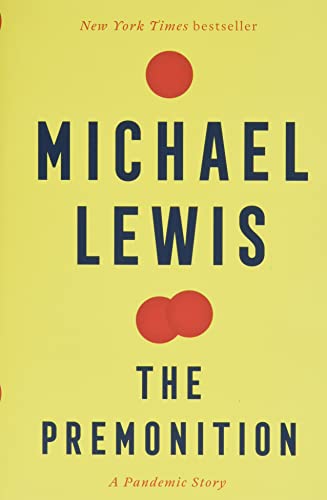
The Premonition: A Pandemic Story
Link to Downlload ⇒ Downlload Now!
Link to Read ⇒ Reaad Now!
Review : New York Times Bestseller For those who could read between the lines, the censored news out of China was terrifying. But the president insisted there was nothing to worry about. Fortunately, we are still a nation of skeptics. Fortunately, there are those among us who study pandemics and are willing to look unflinchingly at worst-case scenarios. Michael Lewis’s taut and brilliant nonfiction thriller pits a band of medical visionaries against the wall of ignorance that was the official response of the Trump administration to the outbreak of COVID-19. The characters you will meet in these pages are as fascinating as they are unexpected. A thirteen-year-old girl’s science project on transmission of an airborne pathogen develops into a very grown-up model of disease control. A local public-health officer uses her worm’s-eye view to see what the CDC misses, and reveals great truths about American society. A secret team of dissenting doctors, nicknamed the Wolverines, has everything necessary to fight the pandemic: brilliant backgrounds, world-class labs, prior experience with the pandemic scares of bird flu and swine flu…everything, that is, except official permission to implement their work. Michael Lewis is not shy about calling these people heroes for their refusal to follow directives that they know to be based on misinformation and bad science. Even the internet, as crucial as it is to their exchange of ideas, poses a risk to them. They never know for sure who else might be listening in. Read more
Review : The Premonition – a pandemic story Michael Lewis ©2021, 304 pp a short Book Report by Ron Housley In place of the usual splash of quotations by adoring fans, this book’s dustjacket has but one lonely testimonial: “I would read an 800 page history of the stapler if he wrote it.†That was exactly my own feeling about Michael Lewis when I pre-ordered my copy. But it’s not always wise to begin a new read with such high expectations, but high they were. Like several of Michael Lewis’ previous books, “The Premonition†rolls along like a train on a mission; in one of the early crescendos, the story of a courageous public health inspector roared to resolution while I had the allegro movement of Shostakovich’s Tenth playing; it was what you’d expect of a grand cinematic climax, all in the first few pages. Michael Lewis is like that; he has given us yet another great story, this time showing us what went on behind the scenes — while we were masked up and locked down. His central theme was the extraordinary government ineptness in responding to the COVID-19 outbreak — ineptness at implementation, but also ineptness in crafting a vision to include cutting-edge discoveries. Now that our country has endured over a year of 24/7, non-stop pandemic coverage, one would think we’d be on solid ground to effectively respond to the next virus. Not so. Lewis shows us why we are not ready; he shows us the deeper, systemic reasons why not: (a)the institutional CYA attitude of the controlling bureaucracies; and (b)refusal of bureaucratic “experts†to admit when new knowledge has the power to legitimately question their entrenched beliefs. The one step which could have thwarted the pandemic spread, and which did stop it in Taiwan and South Korea, was an early deployment of rapid testing, combined with isolation of the infected along with contact tracing. For the pandemic to have been controlled, the critical bullet in the arsenal was rapid testing (and tracing) — but only if done early in the infection’s spread, and only if deployed like a focused military campaign. But this one effective approach was itself thwarted: by the CDC, by the FDA, by political decision makers. Lewis vividly shows us, step by step, how the CDC led with bureaucratic slovenliness, in a cloak of CYA protocols. (It’s little different from the FDA’s reluctance to permit new life-saving drugs because one patient may suffer while the drug rescues millions from a painful death. The FDA rarely feels the sting of criticism for obstructing a great new drug; but they fear the criticism of one single injured patient.) Both these agencies are willing to allow millions to suffer in order to dodge criticisms for allowing one injury. As a result, the CDC was almost worse than useless in controlling the COVID-19 crisis; their refusal to endorse early testing sparked early wildfire spread of the Coronavirus. Their heel dragging was abetted by the FDA which refused to permit the many rapid tests which were already available. Their combined CYA orientation killed masses of human beings — but they are not criticized because all they did was to stand in the way. Even the meager battle that was waged with early testing could never get off the ground. Hospitals were bureaucratically incapable of accepting lab tests offered for free: their computers could not accommodate a $0 entry. Nobody in authority cared whether the test results took 3 hours or 3 days, even though time was of critical importance. The early testing effort languished; more victims got infected and died. Instead of early testing and tracing, what we got instead was mitigation, hurtful political lockdown orders and economic catastrophe. The CDC policy was to act after it was too late. Lewis pounds us with the idea that “beating a pandemic means acting before the danger is clear;†and that requires bureaucratic courage, a trait in short supply. One gauge of prior Michael Lewis books has been the frequency with which my eyes would well up with tears of joy or admiration for some heroic feat, more often than not an intellectual feat. I was not disappointed with this story’s frequency and intensity of heroic flourishes along the pandemic story. It is extraordinary to hear about the exploits of an independent mind; it is quietly satisfying to hear of one independent mind admiring another. That is a unifying thread among the heroes of “The Premonition.†The parade of characters here all had sharp minds; they had courage; they were deserving of our admiration. Lewis used his book to pay homage to their contributions. While it was “a hoot†to see the heroes of the story courageously break through a bureaucratic wall in place to keep the boat from being rocked, the breakthroughs happened too late. Instead we got “stay-at-home†orders, government mandated lockdowns. The breakthrough should have occurred months earlier with a campaign to test potential victims early, so that contact tracing and isolation could have contained the virus. By delaying decisions so long, containment was no longer an option; the only path left was mitigation. It was under mitigation that over 400,000 American lives were lost. I saw Michael Lewis’ book as a refuge from the political battles over the value of “social distancing†and mask wearing. Instead of regarding masks and social distancing as a trip down some rabbit hole, we can instead consider this book’s account of how the disaster was allowed to unfold, of how scientific discoveries do and do not become public policy. It has become clear that those who insist upon dismissing masks, vaccines and social distancing measures are those who never delved into the type of thinking that the intellectual giants in this story have embraced as their own normal. There has always been a tendency to rebel against what is not understood. Michael Lewis paints a frightening picture of us today: we are still woefully uninformed; we still don’t have a grasp of the “big picture;†we still don’t know what to do when the next virus breaks out; the government’s ability to act quickly has still not been developed; the bureaucratic response is still mired in a CYA culture. I can’t imagine what the crowd over at CDC must think of this book: it is a cutting indictment of their entire culture; and it puts the blame for America’s ineffective pandemic response right at their doorstep. Ditto for most of the state level CDC departments. I will be watching with interest to see if any reporter interviews any CDC official, on the record, about the Michael Lewis book; I may be watching for a very long time. I doubt that reporters will even ask; and I have even greater doubts that any CDC official would grace us with an actual assessment. I was surprised to hear NPR review this book; I had assumed that the theme and the contents would be buried by the MainStreet Media altogether — as they have been solidly supportive of all things CDC since the pandemic first showed up at our shores. The media has not shown much willingness to criticize either the CDC or the FDA; I would expect that to continue. But who knows: maybe Michael Lewis will be the catalyst to provoke a fresh look at these once venerable institutions. Lewis continues to be a fine observer of facts on the ground; and he has a nice way of bringing his observations alive.
0 comments:
Post a Comment