The 22 Immutable Laws of Branding
Link to Downlload ⇒ Downlload Now!
Link to Read ⇒ Reaad Now!
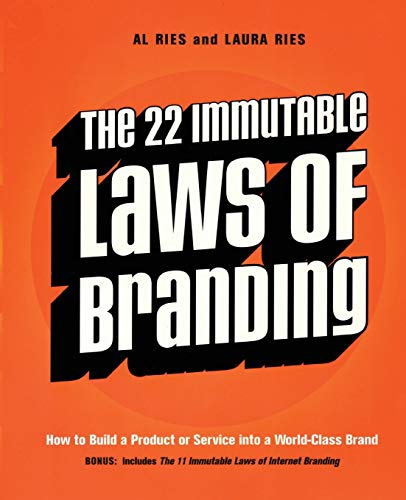
Review : This marketing classic has been expanded to include new commentary, new illustrations, and a bonus book: The 11 Immutable Laws of Internet Branding Smart and accessible, The 22 Immutable Laws of Branding is the definitive text on branding, pairing anecdotes about some of the best brands in the world, like Rolex, Volvo, and Heineken, with the signature savvy of marketing gurus Al and Laura Ries. Combining The 22 Immutable Laws of Branding and The 11 Immutable Laws of Internet Branding, this book proclaims that the only way to stand out in today's marketplace is to build your product or service into a brand—and provides the step-by-step instructions you need to do so. The 22 Immutable Laws of Branding also tackles one of the most challenging marketing problems today: branding on the Web. The Rieses divulge the controversial and counterintuitive strategies and secrets that both small and large companies have used to establish internet brands. The 22 Immutable Laws of Branding is the essential primer on building a category-dominating, world-class brand. Read more
Review : What is a brand? Is it a name? A logo? A funky design or attitude? A brand is a symbol for an idea. More specifically, a brandname is a word that can be uttered in any country, in any `language' and mean the same thing. If a company is consistent and strong in repeating the same message over and over, in time, its brandname will become synonymous with an idea. If the company keeps changing its stripes, the name never catches on, and means nothing. McDonalds is about Family Food. Subway is about Fresh. Pepsi is about Fun If you get really good at this, as a Brand Manager, and you create a brand new product and its name can describe an entire category. A few examples of unbeatable brandnames often mistaken for actual words:Xerox.Band-Aid.RollerBlade. Even the iPod for a time was the `placeholder' word that meant `Digital Music Player'. Moreover, brands are not only synonymous with ideas, they're synonymous with colors. Again, this only works if, after decades of promotion, the company has been consistent:Coca Cola is Red. IBM is Blue. John Deere is Green The list here is short, because frankly, many companies screw this up. They pick the wrong color. They don't pick a color. They pick two colors. Pepsi, though a very successful company, foolishly picked Red and Blue as their colors when going up against the Red of Coca Cola (the leader in the market). Obviously, they should have just gone with deep Blue. They figured it out eventually, but they're still stuck with a blue and red logo. Oops. Not only are companies brands, but people are brands too: How can a man or woman have a strong brand? Stephen King has a brand (though recently he's moved away from horror). Stanley Kubrick had one. So did Steve Jobs. Kobe Bryant and Lebron James have brands too (you have to actually have a brand before you can get paid to put it on a shoe or T-shirt, by the way). Anna Kournikova used to have a brand, but she doesn't play tennis anymore. These are names. And these are people who at some point in their lives were the first at doing something. They found their niche and they excelled. They achieved tremendous success often at a young age. And yes, People can have colors. In the latter half of his career, Steve Jobs was almost never seen (even by his family) without his signature black mock turtleneck. Remember Eminem's white T-shirt and dyed hair? Same thing. When Eminem went away from that, he largely went away from the spotlight. He's basically a producer now. How do you build your corporate and personal brand? Surprisingly, it's not done with ads. In a bit of brilliant irony, most people watching TV (eg. Superbowl ads) assume that advertisements are trying to push a companies products and brands to growth. After all, don't we hear about a company for the first time, when their new product comes out? No. Wrong. That might be what some short-lived companies are trying to do, but that's not possible. The only way to grow is through publicity. And how do you get publicity? How do you get in the New York Times and Financial Post? You get there by being the first and the best. Only when you've achieved something of this stature do you start advertising-not to grow marketshare, but to maintain marketshare you already have. Maybe that's why Amazon.com doesn't need to advertise. And up until recently, Microsoft Windows didn't need advertising either. How could these two companies advertise when they seemed to have no competitors? So look at your own career right now: are you the best in the city at anything? Best in the Country? Best in the world? How can you be number 1 at something? Shrink your focus until you are number one. So, how do you grow? By always being #1, not by growing so much beyond your niche that you're no longer number one. Read that last line again. Look at Amazon: they used to be the worlds biggest bookstore. Now they're calling themselves `Earth's Biggest Selection'. Kinda vague and...is it even true? Probably. But it also means now they're competing against... Wal-Mart. Was that the original Amazon brand? Buying clothes and electronics? No way. Amazon CEO Jeff Bezos is very smart, so he can probably pull it off, but it also leaves room for other companies to swoop in and focus on books. That's probably what the guys at Barnes and Noble are telling themselves. Hopefully, you don't have to worry about competitors like Amazon. Hopefully you don't have to worry about what color their logo is, and what their market share is, because hopefully your company, your product (and your ideas and your personality) are so good that you don't have to own a current market, because you created a new one and own that. More reviews like this on 21tiger
0 comments:
Post a Comment