Executive Presence: The Missing Link Between Merit and Success
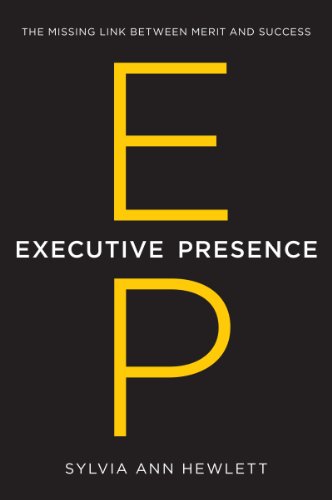
Link to Downlload ⇒ Downlload Now!
Link to Read ⇒ Reaad Now!
Review : Are you “leadership material?†More importantly, do others perceive you to be? Sylvia Ann Hewlett, a noted expert on workplace power and influence, shows you how to identify and embody the Executive Presence (EP) that you need to succeed. You can have the experience and qualifications of a leader, but without executive presence, you won't advance. EP is an amalgam of qualities that true leaders exude, a presence that telegraphs you're in charge or deserve to be. Articulating those qualities isn't easy, however. Based on a nationwide survey of college graduates working across a range of sectors and occupations, Sylvia Hewlett and the Center for Talent Innovation discovered that EP is a dynamic, cohesive mix of appearance, communication, and gravitas. While these elements are not equal, to have true EP, you must know how to use all of them to your advantage. Filled with eye-opening insights, analysis, and practical advice for both men and women, mixed with illustrative examples from executives learning to use the EP, Executive Presence will help you make the leap from working like an executive to feeling like an executive. Read more
Review : Is an executive position part of your career goal? Do you have the necessary skill and experience? Are you wondering why you are not there yet? The subtitle of this immensely useful book, is “The Missing Link Between Merit and Success.†Based on my 22 years of working closely with people in executive positions, I know she has hit the mark – Executive Presence (EP) is the missing link. This is not the first book on looking and sounding like an executive, there have been many before. However, Sylvia Hewlett’s take on this issue rings true where other books I have read left me with a discomfort that something is missing from the explanation. There are two reasons for trusting this book. The first is that Dr Hewlett lived the problem she has tackled in this book. The second is that she has been able to do a piece of credible research that turns the “woolly and elusive concept†of EP into a clear, securely founded, practical model. “Which is why I wrote this book,†she explains. Dr Hewlett grew up in a Welsh mining community, had few clothes, no social graces and spoke English with a thick working-class accent. Despite her formidable intelligence, she failed her interview for a place at Oxford University despite qualifying, because she was so inappropriately dressed for the situation. (Not knowing any better, she had dressed like the Queen Mother!) She also qualified for Cambridge University and after the interview at which she dressed more appropriately, was accepted into the University. She taught Economics at Barnard College (associated with Colombia University) where she initially had difficulty convincing anyone she was a professor and not a student, and was not taken seriously by faculty. Aged 27, (which is very young for such a position,) she her hair waist-long and wore flowing ethnic skirts. “I now understand that my early struggles to command attention and respect in lecture halls and faculty meetings did not center on content or delivery (I was a clear, crisp speaker and knew my material cold), but rather centered on the way I presented myself.†If the first reason for trusting this book is the author’s personal experience, second reason, is the research conducted through the Center for Talent Innovation, where Dr Hewlett is President and CEO. Her research team conducted a national survey involving nearly 4,000 college-educated professionals. Included in the cohort were 268 senior executives. The research aimed to ascertain what co-workers and executives look for when they evaluate an employee’s EP. Without Executive Presence, no one attains a top position, lands an extraordinary deal, or develops a significant following. Executive presence is not a measure the person’s ability and performance, rather it is a measure of the image you project that you “have what it takes, that you are star material.†Each year the Concert Artists Guild hosts an international competition. From an applicant pool of 350 instrumentalists and singers from all over the world, 12 extraordinary young musicians are brought to the Merkin Concert Hall in New York City where a distinguished jury judges the finalists. What emerges with regularity is the importance of non-musical factors in the final judgement. Did the musician smile, exhibit confidence, make eye contact with the audience, and so on? The world of work is no different. Executive Presence is comprised of three pillars that apply across all industries, all business types and all economies. The specifics differ vastly. What is required in a high-end law firm is not the same as in a chain of supermarkets, a hospital, or and marketing firm. The three pillars are “Gravitas†how you act, “Communication†how you speak, and “Appearance†how you look. These pillars are not of equal importance. “Gravitas†was identified as mattering most by 67% of the 268 executive in the survey. “Gravitas†implies knowing your field exceptionally well. “Appearance†might seem to be highly important from my introduction to this column, but it is not, rated only 5% of what makes up Executive Presence. “Communication†was rated 28%. Gravitas is not only projecting intellectual horsepower, but also having the confidence and credibility to get heard and accepted. Gravitas has six components. The first is confidence and projecting “grace under fireâ€. It is when under attack that this element of EP shows. We know we are in the presence of a leader when he or she remains calmly in control in the most difficult of circumstances. Then there is decisiveness, holding to a carefully thought through position and being threatening if necessary. Behind this is integrity, being able to “speak truth to power,†where others are not. While decisiveness and confidence signal conviction, courage, and resolve in a leader, when these are not accompanied by empathy, they look like egotism, arrogance, and insensitivity. A leader’s reputation needs to be nurtured and guarded because it goes before one has even appeared. Finally, leaders need a vision. Effective communication, the second pillar of Executive Presence is critical. As I have written a number of times in the column, a brilliant idea poorly presented sounds like a poor idea. A great comfort emerges form the research conclusions on Appearance, the third pillar of Executive Presence. Appearance is defined as “grooming and polish†rather than “physical attractiveness†or “body type†according to the respondents. These, fortunately, can be corrected where “physical attractiveness†or “body type†usually cannot. “Crack the EP code you’ll be first in line for the next plum assignment and be given a chance of doing something extraordinary with your life,†asserts Dr Hewlett. To do that, read this book. It is an easy read full of accounts of familiar business executive and other leaders. The book will keep you engaged as you learn this most crucial lesson. Readability Light -+--- Serious Insights High -+--- Low Practical High -+--- Low
0 comments:
Post a Comment