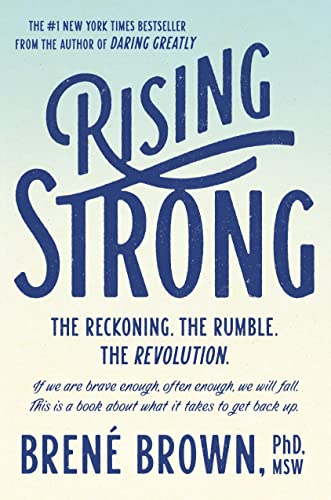
Rising Strong: The Reckoning. The Rumble. The Revolution.
Link to Downlload ⇒ Downlload Now!
Link to Read ⇒ Reaad Now!
Review : #1 NEW YORK TIMES BESTSELLER • When we deny our stories, they define us. When we own our stories, we get to write the ending. Don’t miss the five-part HBO Max docuseries Brené Brown: Atlas of the Heart ! Social scientist Brené Brown has ignited a global conversation on courage, vulnerability, shame, and worthiness. Her pioneering work uncovered a profound truth: Vulnerability—the willingness to show up and be seen with no guarantee of outcome—is the only path to more love, belonging, creativity, and joy. But living a brave life is not always easy: We are, inevitably, going to stumble and fall. It is the rise from falling that Brown takes as her subject in Rising Strong . As a grounded theory researcher, Brown has listened as a range of people—from leaders in Fortune 500 companies and the military to artists, couples in long-term relationships, teachers, and parents—shared their stories of being brave, falling, and getting back up. She asked herself, What do these people with strong and loving relationships, leaders nurturing creativity, artists pushing innovation, and clergy walking with people through faith and mystery have in common? The answer was clear: They recognize the power of emotion and they’re not afraid to lean in to discomfort. Walking into our stories of hurt can feel dangerous. But the process of regaining our footing in the midst of struggle is where our courage is tested and our values are forged. Our stories of struggle can be big ones, like the loss of a job or the end of a relationship, or smaller ones, like a conflict with a friend or colleague. Regardless of magnitude or circumstance, the rising strong process is the same: We reckon with our emotions and get curious about what we’re feeling; we rumble with our stories until we get to a place of truth; and we live this process, every day, until it becomes a practice and creates nothing short of a revolution in our lives. Rising strong after a fall is how we cultivate wholeheartedness. It’s the process, Brown writes, that teaches us the most about who we are. ONE OF GREATER GOOD ’S FAVORITE BOOKS OF THE YEAR “[Brené Brown’s] research and work have given us a new vocabulary, a way to talk with each other about the ideas and feelings and fears we’ve all had but haven’t quite known how to articulate. . . . Brené empowers us each to be a little more courageous.†—The Huffington Post Read more
Review : Rising Strong Brene Brown Rising Strong Book CoverDr. Brene Brown, research professor at the University of Houston and CEO of the Daring Way, adds to and builds on her previous work (I Thought It Was Just Me, The Gifts of Imperfection, Daring Greatly) in her new book, Rising Strong. I highly recommend that you read the others as well, but this book is still significant on it’s own. Through her interviews with thousands of people, she developed Rising Strong. The goal of the Rising Strong process is, “to rise from our falls, overcome our mistakes, and face hurt in a way that brings more wisdom and wholeheartedness†(2015, p. 40). This is described as a very messy three-step process: The Reckoning: We need to identify and have an awareness of our emotions. Then we allow ourselves to be curious about our emotions and look for how they connect to our patterns of thought and behavior. The Rumble: This is getting very honest about the stories we tell about others and ourselves. We have a tendency to fill in the information gaps in our narratives, which is likely not accurate. It is very important that we believe that people really are doing the best they can with their lives. We need to challenge our initial reactions and look for a deeper level of understanding. The Revolution: Once we have rumbled with and owned our story, we then can rewrite the ending by growing and learning from what we have learned. Dr. Brown writes: Men and women who rise strong integrate the key learnings that emerge from the rising strong process into how they live, love, lead, parent, and participate as citizens. This has tremendous ramifications not only on their own lives, but also for their families, organizations, and communities. (p. 41) The process of applying your new insights will revolutionize your world. Critical Review Dr. Brown has a very connectable approach to her writing and weaves in a number of personal stories that make this process human. Her work is brilliant, unassuming, and yet still feels like it could be a great conversation with a best friend over coffee. This is not your typical academic research book filled with complex methodologies and two-way ANOVAs. Dr. Brene Brown has managed to take her complex grounded theory research and translate it into concepts that are useful for anyone with a soul. On the other hand, if you are a super academic social scientist type person, she does not fully explain her entire methodology and provide all the explicit details of that process. However, this would not be appropriate to her audience. I do appreciate the fact that she lists all of her references in the back of the book. You can further your reading and double-check many of the statements she makes if you have concerns. I value that level of research transparency and how she has put her work out there for criticism. She also includes highlights from her other works at the end of the book. My Own Experience I noted several significant takeaways in the process of reading this book. Actually, there are too many to mention, so I will give some highlights. It is very important to teach our children the truth of our stories and our family histories because it is their story. Nostalgia can be deadly. The term chandeliering is one consequence of ignoring our own emotional pain. The term describes when a minor comment or conflict triggers a pain so great that we “jump as high as the chandelier†with our emotional response (p. 60). Some examples are road rage or even losing it at a sporting event. Dr. Brown writes: Chandeliering is especially common and dangerous in “power-over†situations-environments where, because of power differentials, people with a higher position or status are less likely to be held accountable for flipping out or overreacting…Most of us have been on the receiving end of one of these outbursts. Even if we have the insight to know that our boss, friend, colleague, or partner blew up at us because something tender was triggered and it’s not actually about us, it still shatters trust and respect. (p. 61-62) I enjoyed all of the personal stories. I cherished from my family systems background the insight into Dr. Brown’s family of origin. What moved me most was the account of her mother having a life altering counseling experience that was then translated into her parenting. It is a reminder that we can all change our family trees and break negative intergenerational patterns. On spirituality, I also had a few notes. Dr. Brown’s work suggests that no specific church denomination was more shaming than others. Over half of her participants who experienced spiritual shaming ended up finding healing through spirituality. They changed churches or beliefs, but their faith was still a significant part of who they are. Some items I need to reflect on personally after reading this are having the courage to communicate what works for me (what I need) and renewing my faith that people are doing their best at all times. As a lover of Narrative Therapy, I am all for reauthoring our own stories.
0 comments:
Post a Comment