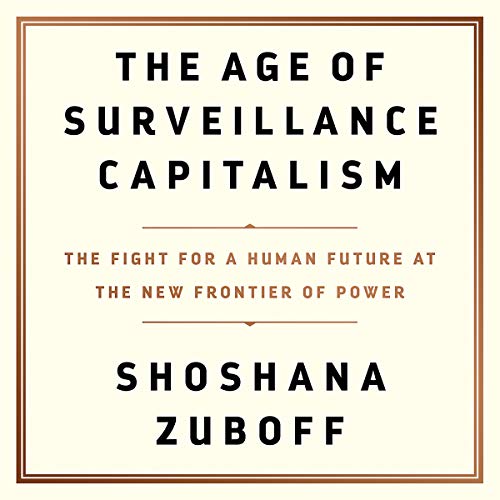
The Age Of Surveillance Capitalism: The Fight for a Human Future at the New Frontier of Power
Link to Downlload ⇒ Downlload Now!
Link to Read ⇒ Reaad Now!
Review : The challenges to humanity posed by the digital future, the first detailed examination of the unprecedented form of power called ""surveillance capitalism,"" and the quest by powerful corporations to predict and control our behavior. Shoshana Zuboff's interdisciplinary breadth and depth enable her to come to grips with the social, political, business, and technological meaning of the changes taking place in our time. We are at a critical juncture in the confrontation between the vast power of giant high-tech companies and government, the hidden economic logic of surveillance capitalism, and the propaganda of machine supremacy that threaten to shape and control human life. Will the brazen new methods of social engineering and behavior modification threaten individual autonomy and democratic rights and introduce extreme new forms of social inequality? Or will the promise of the digital age be one of individual empowerment and democratization? The Age of Surveillance Capitalism is neither a hand-wringing narrative of danger and decline nor a digital fairy tale. Rather, it offers a deeply reasoned and evocative examination of the contests over the next chapter of capitalism that will decide the meaning of information civilization in the twenty-first century. The stark issue at hand is whether we will be the masters of information and machines or its slaves. Read more
Review : This is a very important book which alerts us to the dangers of losing our privacy, independent decision-making and democracy in the impending age of Surveillance. The digital age promised to give us a world of personalized information, communication, shopping and entertainment at our finger-tips and we were enticed by the prospect of instant gratification. At the same time we were completely unaware that more and more private information about our habits, likes and dislikes was being mined from our internet searches and sold off to the highest bidder. Shoshana Zuboff traces this intriguing story of the step by step transformation of what was to be an age of personalized information into an age of surveillance. Apple's iTunes Store was opened in 2003 and quickly became the world's largest online music service, with over 25 billion downloads by 2013. Personalized digital music was here to stay. Google set out to make profits from its personalized Adwords and Adsense after its Search application proved immensely successful with its users but generated no revenue. While learning to improve predictions of user clicks and "likes", Google and later Facebook discovered a gold-mine in trading user's behavioral surplus, which turned both companies into "fortune-telling giants" "This was all based on accumulating more and more user data because" Google’s machine intelligence capabilities feed on behavioral surplus, and the more surplus they consume, the more accurate the prediction products that result" Serving its users was no longer Google's main priority but became a means to a far more lucrative end .Our lives became the raw materials for this new process of production. Shoshan Zuboff writes "Google would no longer mine behavioral data strictly to improve service for users but rather to read users’ minds for the purposes of matching ads to their interests, as those interests are deduced from the collateral traces of online behavior. With Google’s unique access to behavioral data, it would now be possible to know what a particular individual in a particular time and place was thinking, feeling, and doing." This "digital dispossession" took place in secret and paved the way to more ambitious goals which pried much deeper into the details of our offline lives. Larry Page, one of the co-founders of Google expressed it this way :" "People will generate enormous amounts of data. . . . Everything you’ve ever heard or seen or experienced will become searchable. Your whole life will be searchable.†With Google Maps and Street View privacy has been further reduced. After "cookies" to track our online browsing, the next step is pervasive emotion scanning and emotional analytics based on our "likes" , recordings of our voice and our facial expressions. This is not science fiction. At least one company, Emoshape.. produces a microchip which delivers “high performance machine emotion awareness†which.. can classify twelve emotions with up to 98 percent accuracy." In addition "Samsung acknowledges that the voice commands aimed at triggering the TV’s voice-recognition capabilities are sent to a third party". There are now toy dolls that can spy on us, robot floor cleaners that sell our floor plans to third parties and its getting more and more difficult to opt out because even if you can read and understand the complicated click-through agreements which manufacturers provide and opt out of the right to sell your information to third parties, you end up with degraded products with much reduced functionality. The technology of surveillance advances much faster than legislation and since 911 governments have been more desperate to catch terrorists than protect privacy. Cyberspace has become the new "wild west" a lawless frontier. The next two stages are even more frightening: "ubiquitous computing" and behavioral control. Ex Ceo of Google, Schmidt sees the internet disappearing in future because sensors and devices will be everywhere including wearables and the walls of every room so we will be permanently online. Behavioral control starts with little nudges to manipulate us and "fake news" that has already swayed our election results. The Pokemon game showed a way to nudge users to particular locations where businesses would pay for each visit .In future we will have individual insurance policies based on monitoring our driving with sensors, and then giving reduced premiums to careful drivers while switching off the engine of dangerous drivers .Maybe we will have fridges that automatically shut to prevent gluttony because we are overweight. There is also the Microsoft automatic factory which integrates machine and human behavior automatizing both. There is no doubt that Shoshana Zuboff is right about the need for action and legislation to preserve our freedom before it is too late. Unfortunately, having presented all the facts, she dwarfs the real problem with ideology by claiming that surveillance capitalism is the major problem, a vampire devised to exploit us and impoverish us by giving an unfair advantage to rogue capitalists who distort the classic market (where the future is unknown) by manipulating consumers and employing so few workers. She writes "Most startling is that GM employed more people during the height of the Great Depression than either Google or Facebook employs at their heights of market capitalization." It makes no sense to blame Google and Facebook who pay higher wages than other companies for contributing towards the increasing inequality of income in capitalist societies in the last 50 years. Automation is probably the main cause of depressing wage incomes and increasing income from capital. The surveillance economy is still a very small part of our economy and cannot be blamed for all the unrest of the last 50 years. She writes: "The surveillance capitalists reverse the normal sequence of theory and practice. Their practices move ahead at high velocity in the absence of an explicit and contestable theory. The only way to grasp the theory advanced in their applied utopistics is to reverse engineer their operations and scrutinize their meaning, as we have done throughout these chapters." In other words, she uses the very absence of an ideology or guiding theory in surveillance capitalism to justify inventing one, using the predictions of a few leading data scientists. Since Plato's concept of philosopher kings, there have always been some philosophers, writers and now scientists who preferred enlightened despotism to democracy. This doesn't entitle Shoshana Zuboff to marry Skinner's ideas of totalitarian rule by scientists (for the "greater good") to surveillance capitalism in general. Even worse, the few pages that this book devotes to the surveillance state and its foremost exemplary China are enough to show that real totalitarianism is very easy to spot. This brings me to my most important criticism of this book. We are in danger of living in a surveillance society and every crisis in this overcrowded world, like the corona crisis brings solutions which further encroach on our privacy (e.g a health passport) with more personal monitoring. There are too many reasons to use surveillance technology which are not connected to the profit motive. The Chinese are already living in a state where your every move is surveyed by camera and you are granted a social grade for your behavior. Adopting unsuitable friends can lower your social grade which will block you from buying a train ticket. At the end of the day, the problem is not an economic one of "surveillance capitalism" but how to avoid the encroachment of surveillance on all aspects of our life and preserve our rights to privacy and democracy.
0 comments:
Post a Comment