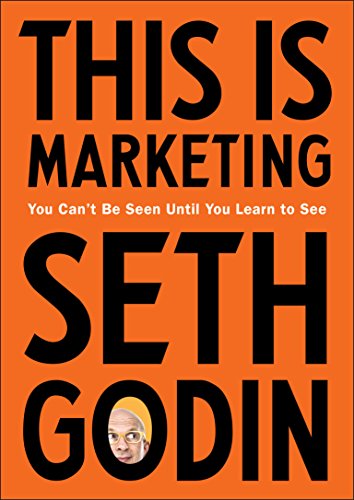
This Is Marketing: You Can't Be Seen Until You Learn to See
Link to Downlload ⇒ Downlload Now!
Link to Read ⇒ Reaad Now!
Review : #1 Wall Street Journal Bestseller Instant New York Times Bestseller A game-changing approach to marketing, sales, and advertising. Seth Godin has taught and inspired millions of entrepreneurs, marketers, leaders, and fans from all walks of life, via his blog, online courses, lectures, and bestselling books. He is the inventor of countless ideas that have made their way into mainstream business language, from Permission Marketing to Purple Cow to Tribes to The Dip . Now, for the first time, Godin offers the core of his marketing wisdom in one compact, accessible, timeless package. This is Marketing shows you how to do work you're proud of, whether you're a tech startup founder, a small business owner, or part of a large corporation. Great marketers don't use consumers to solve their company's problem; they use marketing to solve other people's problems. Their tactics rely on empathy, connection, and emotional labor instead of attention-stealing ads and spammy email funnels. No matter what your product or service, this book will help you reframe how it's presented to the world, in order to meaningfully connect with people who want it. Seth employs his signature blend of insight, observation, and memorable examples to teach you: * How to build trust and permission with your target market. * The art of positioning--deciding not only who it's for, but who it's not for. * Why the best way to achieve your goals is to help others become who they want to be. * Why the old approaches to advertising and branding no longer work.  * The surprising role of tension in any decision to buy (or not). * How marketing is at its core about the stories we tell ourselves about our social status. You can do work that matters for people who care. This book shows you the way. Read more
Review : This is the first book I read by Godin, and I've enjoyed it so much that I will certainly read more of his works in the future. In the past I read marketing books for pleasure, not to be 'manipulated' by advertisers, i.e. as a shield kind of thing. Cialdini's first book ('Influence') has always been a book of reference for me in that regard. However, I've always felt that it fell short for the needs of the modern contemporary Internet-dominated society and market. This is Marketing fills the gap, adding elements that are relevant to the social, cultural and marketing reality of the 21st century; elements that I can use to think about selling my services without having to think about learning psychological tactics that are already well-known, have been used and overused for decades, and no longer work. TARGET READER > Godin's book is a more a book that gives you food-for-thought than a book that provides you with a proper system to implement things. Godin himself states that this is not a step-by-step set of tactics by a compass and, to me, that's true. To me that's inspirational. > I see the book more targeted to lay people and small biz entrepreneurs than a book devoted to professional marketers, who might react with a 'what?!" to some of the points that Godin makes. GODIN'S CORE MARKETING PRINCIPLES + Marketing seeks more market share, more customers, and more work. + Marketing is driven by better service, better community, and better outcomes. + Marketing creates culture: Status, affiliation, and people like us. + Marketing is change: Change the culture, change your world. Marketers make change happen. + Each of us is a marketer and has the ability to make more change than we can imagine. + Our opportunity and our obligation is to do marketing that we’re proud of. GREAT THINGS + The thing I like the most about this book is Godin's understanding of contemporary group dynamics, conformity trends, cultural disruption, and cultural influence. Above all, what stands out to me is the author's emphasis on serving the client or customer, treating them with respect, and not selling yourself too short in the process. + Probably because I experience the over-dominance of Facebook and Google as something dangerous and even burdensome, I loved Godin's insistence on narrative instead of advertising, and on care as a way to obtain profit. + Godin debunks the fallacy of the efficiency of FB and Google paid adds in marketing small businesses. + The book reads with gusto, and has a very simple language. + Some of the examples that Godin uses to exemplify his points are really good, too. + The explanation of why the same book gets both 1-star and 5-star reviews is really good. + The advice on how to treat loyal customers who ring a call center to complain. + The definition of goal, and how it differs from a strategy and a tactic. + The difference between direct marketing and brand marketing, and why the latter is better for your biz. + The selected readings list at the end of the book is really good. MY FAVORITE NUGGETS > "Online advertising is also the most ignored advertising ever created. It’s not unusual to run an ad in front of a hundred thousand people and get not a single click. It’s not unusual for an entire ad campaign to start, run, and finish without making any impact on the culture. (p. 169). > "If you’re buying direct marketing ads, measure everything. Compute how much it costs you to earn attention, to get a click, to turn that attention into an order. Direct marketing is action marketing, and if you’re not able to measure it, it doesn’t count." (p. 172). > "The lifetime value of a new customer rarely exceeds the cost of running the ads necessary to get a new customer. People are so distrustful, and the web is so cluttered, that the ads rarely have enough power to pay for themselves." (p. 210). > "Lowering your price doesn’t make you more trusted. It does the opposite." (p. 185). WHERE TO START READING ~ The Simple Marketing Sheet at the end of the book, especially if you get to book to help you market something you want to sell. ~ Chapter 23, because it summarizes the main points discussed in the book . DOWNSIDES __ The core message is repeated over and over again, sometimes unnecessarily. __ I would have loved that Godin provided a few more examples on certain points he makes to make his advice more precise and less generic. __ Some statements are a bit vague. An example: "And then, with this knowledge, overdo your brand marketing. Every slice of every interaction ought to reflect the whole. Every time we see any of you, we ought to be able to make a smart guess about all of you." (p. 175). __ The book reads like an upgraded collection of blog entries, which makes a great read, but lacks the patina of seriousness that makes things trustworthy for the newcomer. When you get a footnote system where you back what you say, the trust is immediately there; when you don't do that, I have the doubt whether some of the statements are hyperbolic or just a way of speaking. No doubt, Godin is a powerful voice in the marketing world, but I have difficulties taking bombastic statements at face value, no matter how much I like the speaker. __ Godin defines marketing in p. 2 as "the generous act of helping someone solve a problem. Their problem". I consider that BS, sorry. I think marketing is the act of selling something to people who might need or not need it, might want it or not, especially the act of selling to people who would initially say no to something. __ Godin repeats over and over that marketers create change. I think that's a bit of BS, too. The way I see it is, marketers sell change, and that's great in itself. People who really make change in the world, do so mostly outside the marketing world, sorry. The world of ideas, the word of science, the world of art, the world of technology. I see change coming from scientists, philosophers, artists, and innovators, not so much from marketers. Navel-looking hyperbolas work when giving a conference, in a book, not so much. MIND Godin himself states that the book is based on a hundred-day seminar that involved both lessons and peer-to-peer coaching around shared work. (p.2), and that some bits of his blog are also incorporated (p. 259). BAD ENGLISH > “Treat the others the way you’d want to be treated.†(p. 234). > “Build a team with the capacity and the patience to do the work that needs doing.†(p. 235).
0 comments:
Post a Comment